Why Schools Should Teach Creationism Alongside Evolution
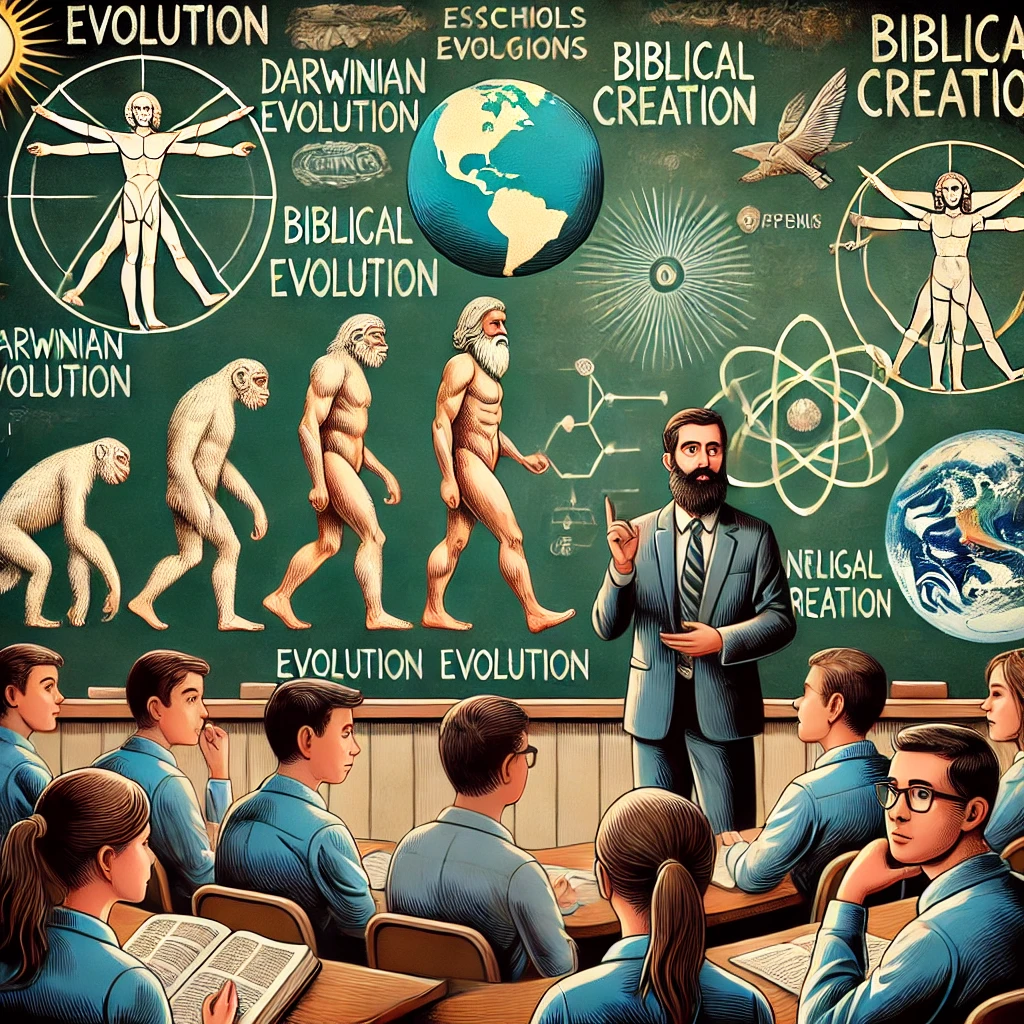
The debate over creationism vs. evolution in public education has been ongoing for decades. While evolution is widely taught in schools as the foundation of biological science, creationism is often excluded under the premise that it is religious rather than scientific. However, this one-sided approach is intellectually dishonest and denies students the opportunity to critically evaluate different perspectives on the origins of life.
If evolution is taught as the only explanation, students are not given a full scope of scientific inquiry. This article explores why creationism should be taught alongside evolution in schools, the flaws in evolutionary theory, and why excluding creationism is a violation of academic freedom.
1. The Case for Teaching Creationism in Schools
1.1 Science Encourages Open Inquiry
- True scientific education should encourage open dialogue and critical thinking, rather than presenting one view as absolute truth.
- Scientific discoveries have often challenged mainstream thought, and allowing multiple perspectives fosters intellectual growth.
- If evolutionists claim to follow the scientific method, then creationism should be evaluated fairly, rather than dismissed outright.
1.2 Many Scientists Question Evolution
- The theory of evolution is not as “settled” as many believe. Thousands of scientists worldwide have expressed skepticism about Darwinian evolution.
- Complex biological structures, such as DNA and cellular mechanisms, indicate an intelligent design rather than random mutations.
- Many leading scientific minds—including Isaac Newton and Louis Pasteur—held strong creationist beliefs.
Resource: Discovery Institute – Scientific Dissent from Darwinism
1.3 Academic Freedom and Fair Representation
- Schools promote diversity of thought, yet they often restrict discussion to only one explanation of origins.
- If schools teach evolution, then presenting an alternative scientific theory like creationism is only fair.
- Students should be allowed to examine both perspectives and decide for themselves.
2. Scientific Evidence Supporting Creationism
2.1 Irreducible Complexity
- Certain biological systems, such as the bacterial flagellum, require all their parts to be present simultaneously to function.
- If a system could not have evolved step by step, then it suggests intelligent design rather than gradual evolution.
- The complexity of the human eye, blood clotting mechanisms, and DNA replication all demonstrate irreducible complexity.
Resource: Intelligent Design & Irreducible Complexity – Discovery Institute
2.2 Fine-Tuning of the Universe
- The universe operates under precisely calibrated physical constants, such as:
- The strength of gravity
- The balance of nuclear forces
- The exact composition of Earth’s atmosphere
- If any of these variables were slightly different, life could not exist.
- This fine-tuning points to an intentional Designer rather than random chance.
Resource: Institute for Creation Research – The Anthropic Principle
2.3 Lack of Transitional Fossils
- Darwin’s theory predicts gradual changes over millions of years, yet the fossil record lacks clear transitional forms.
- The Cambrian Explosion, where fully formed species appear suddenly, contradicts slow evolutionary processes.
- Many supposed “transitional fossils” have been debunked or proven to be distinct species.
Resource: Answers in Genesis – Problems with Evolution
2.4 The DNA Code and Information Theory
- DNA functions as a complex, information-carrying code, similar to a computer program.
- Codes require an intelligent sender; they do not originate from random mutations.
- The presence of specific, purposeful genetic sequences is strong evidence for design rather than randomness.
Resource: Creation Ministries International – DNA and Intelligent Design
3. The Bias Against Creationism in Schools
3.1 Selective Exclusion is Unfair
- Evolution is taught as if it is a proven fact, yet alternative theories are censored.
- Schools argue that creationism is “religious” while ignoring that evolution is also based on unprovable assumptions.
- If schools claim to be “neutral,” then they should allow both sides to be discussed rather than imposing a one-sided narrative.
3.2 Evolution as a Worldview, Not Just Science
- Evolutionary theory shapes philosophy, ethics, and human identity, making it more than just a biological explanation.
- Secular humanism, which relies on evolutionary thinking, is itself a belief system that influences public education.
- Why is one belief system allowed in schools while another is banned?
Resource: Institute for Creation Research – The Bias of Evolutionary Teaching
4. The Benefits of Teaching Creationism Alongside Evolution
4.1 Encourages Critical Thinking
- When students analyze multiple theories, they develop better reasoning skills.
- One-sided teaching leads to intellectual stagnation, while debate fosters deeper understanding.
4.2 Aligns with Religious Freedom and Parental Rights
- Many parents want their children to learn creationism, yet schools ignore their concerns.
- Excluding creationism from education violates religious freedoms and parental rights.
4.3 Allows for a Fuller Understanding of Science
- A balanced curriculum acknowledges that science is not settled but constantly evolving.
- Many scientific advancements have proven biblical concepts, such as the complexity of life and the fine-tuning of the universe.
Resource: BADA EDUCATION – Science & Faith Studies
5. Addressing Common Objections
Objection 1: “Creationism is Not Science”
Response: Science involves investigation, observation, and critical thinking. Creationism presents a logical framework for life’s origins based on scientific evidence of design.
Objection 2: “Evolution is Proven”
Response: Evolution remains a theory, not a proven law, and many scientists question its validity.
Objection 3: “Teaching Creationism Violates Separation of Church and State”
Response: Teaching one-sided evolutionary theory promotes secular humanism, which is itself a worldview and belief system.
Final Thoughts
The exclusion of creationism from schools is not about science—it is about controlling the narrative. If public education is truly committed to academic freedom, then students should be allowed to explore both evolution and creationism.
Why should only one view be allowed while silencing another?
By teaching both, schools promote open discussion, critical thinking, and fairness—all of which are essential in a true educational environment.