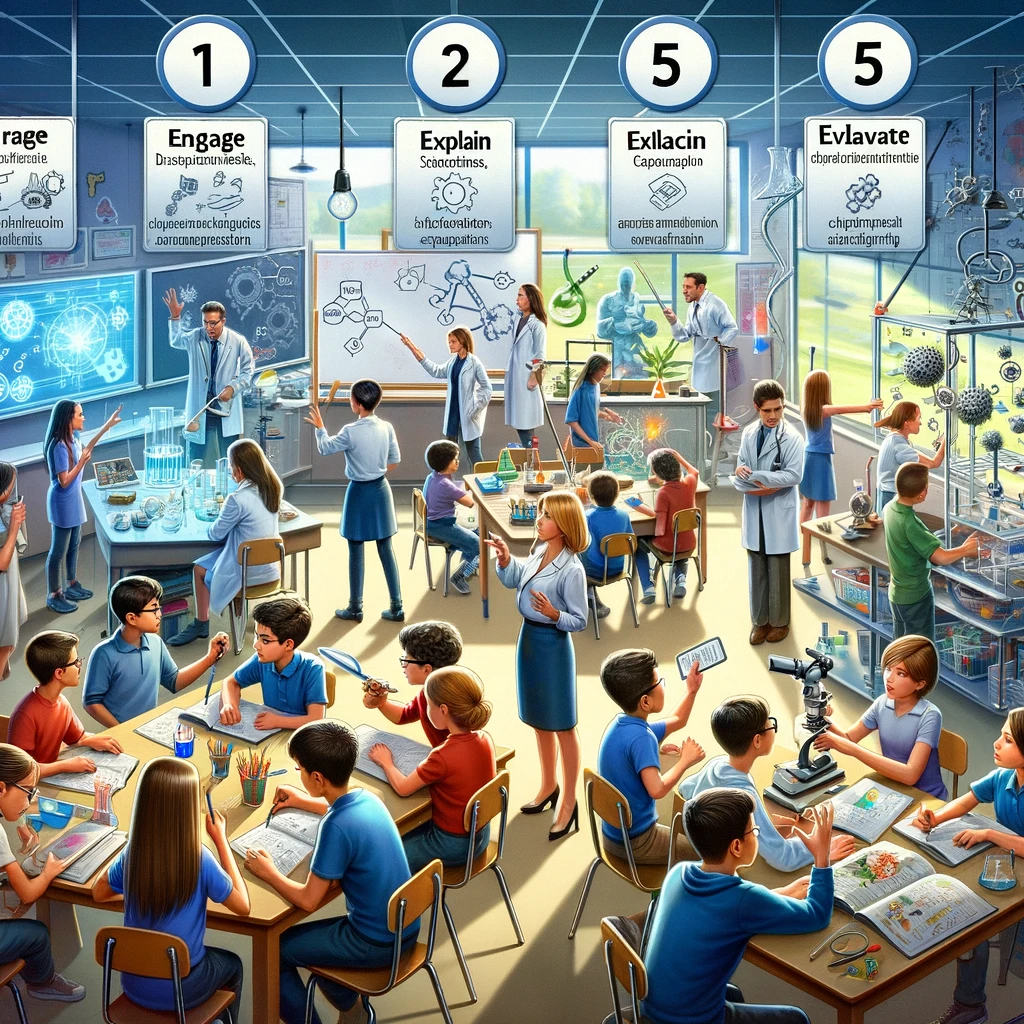
Effective science instruction goes beyond memorization—it should inspire curiosity, critical thinking, and real-world problem-solving. The 5E Model of Inquiry-Based Learning provides a structured framework to engage students, promote exploration, and deepen their understanding of scientific concepts.
In this article, we explore how the 5E Model enhances science instruction, its benefits, and how educators can implement it effectively to create dynamic learning experiences.
1. What is the 5E Model?
The 5E Model is an instructional framework designed to facilitate inquiry-based learning in science classrooms. It consists of five phases:
- Engage – Capture students’ interest and assess prior knowledge.
- Explore – Encourage hands-on investigations and experimentation.
- Explain – Facilitate discussions and introduce new concepts.
- Elaborate – Apply learning to real-world scenarios and deepen understanding.
- Evaluate – Assess comprehension and encourage self-reflection.
This cyclical model encourages student-driven discovery while providing structure for educators to guide learning effectively.
Resource: National Science Teaching Association (NSTA)
2. The Benefits of the 5E Model in Science Education
2.1 Enhancing Student Engagement
- The Engage phase taps into students’ natural curiosity, making them excited to learn.
- Inquiry-driven instruction creates active participation rather than passive learning.
2.2 Promoting Inquiry-Based Learning
- Students develop critical thinking skills by forming hypotheses and conducting experiments.
- Encourages students to ask questions, explore solutions, and draw conclusions based on evidence.
2.3 Deepening Conceptual Understanding
- The Explain and Elaborate phases reinforce concepts through discussion and real-world applications.
- Students make connections between scientific principles and everyday experiences.
2.4 Supporting Differentiated Instruction
- The model accommodates diverse learning styles, providing opportunities for hands-on, visual, and verbal learning.
- Allows educators to adjust activities based on student needs and learning paces.
Resource: STEM Education Coalition
3. How to Implement the 5E Model in Science Lessons
3.1 Engage: Sparking Curiosity
- Start with a thought-provoking question, video, or demonstration.
- Use real-world scenarios to connect science to students’ lives.
Example: Show a mystery experiment (e.g., mixing baking soda and vinegar) and ask students to predict what will happen.
3.2 Explore: Hands-On Investigations
- Provide materials for students to experiment with and discover concepts on their own.
- Encourage teamwork and discussion as students test hypotheses and record observations.
Example: In a physics lesson on friction, allow students to test different materials to see how surfaces affect motion.
3.3 Explain: Introducing Key Concepts
- Facilitate discussions where students share their observations and findings.
- Introduce scientific vocabulary and connect it to students’ experiences.
Example: In a biology lesson on plant growth, discuss photosynthesis and connect it to observations from a classroom plant experiment.
3.4 Elaborate: Applying Knowledge to Real-World Situations
- Extend learning through projects, simulations, and cross-disciplinary connections.
- Encourage students to develop their own experiments or apply knowledge creatively.
Example: Challenge students to design an energy-efficient home model based on heat transfer principles.
3.5 Evaluate: Assessing Learning and Reflection
- Use a variety of assessments, including projects, quizzes, and student reflections.
- Encourage students to self-assess their learning progress and think about improvements.
Example: Have students create an infographic summarizing their experiment and key takeaways.
Resource: Edutopia – Inquiry-Based Science Education
4. The 5E Model in Action: Sample Science Lesson Plan
Lesson Topic: The Water Cycle
| 5E Phase | Activity |
|---|---|
| Engage | Show a time-lapse video of a lake evaporating and forming clouds. Ask: Where does the water go? |
| Explore | Have students create mini water cycle models using plastic bags, water, and sunlight. |
| Explain | Discuss evaporation, condensation, precipitation, and collection using student observations. |
| Elaborate | Have students apply their understanding by designing a sustainable water filtration system. |
| Evaluate | Assess learning through a diagram drawing activity and student-led presentations. |
Resource: National Science Foundation
5. Future Trends: Enhancing the 5E Model with Technology
5.1 Virtual and Augmented Reality for Exploration
- Virtual labs allow students to conduct science experiments safely and repeatedly.
- AR applications provide immersive experiences in space exploration, anatomy, and molecular biology.
5.2 AI-Powered Personalized Learning
- Adaptive learning platforms tailor science lessons based on student performance and engagement.
- AI chatbots assist students by answering science-related questions in real time.
5.3 Gamification and Interactive Simulations
- Game-based learning increases student motivation and retention of complex scientific concepts.
- Interactive tools like PhET simulations make abstract concepts more tangible.
Resource: BADA EDUCATION – Inquiry-Based Science Learning
Final Thoughts
The 5E Model transforms science education by promoting curiosity, active learning, and real-world connections. By implementing this framework, educators can create engaging lessons that encourage scientific discovery and lifelong learning.
Whether you’re teaching elementary students about weather patterns or high school students about chemical reactions, the 5E Model provides a structured yet flexible approach to inquiry-based learning.
Are you ready to enhance science engagement in your classroom? Start implementing the 5E Model today!