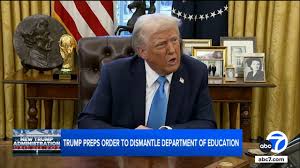
A recently leaked memo has confirmed that former President Donald Trump is planning to eliminate the U.S. Department of Education, a move that has sparked widespread debate among educators, policymakers, and students. If implemented, this drastic shift could fundamentally reshape the nation’s education system, transferring power from the federal government to individual states.
In this article, we will explore why Trump is pushing for this change, how it could impact students and teachers, and what the future of education might look like without the Department of Education.
1. Why Does Trump Want to Eliminate the Department of Education?
1.1 Reducing Federal Government Control
- Trump has long advocated for reducing federal oversight in education, arguing that decisions should be made at the state and local levels.
- He believes that the Department of Education has overstepped its role, imposing bureaucratic policies that interfere with effective teaching and learning.
1.2 Shifting Power to States
- The plan to eliminate the Education Department aligns with conservative views that states should have full control over their own education policies.
- This could lead to more localized decision-making but also raise concerns about disparities in educational quality across states.
1.3 Cutting Government Spending
- The federal budget allocates billions of dollars to the Department of Education each year.
- By dissolving the department, Trump argues that taxpayer money could be better spent elsewhere, such as reducing the national debt or funding school choice initiatives.
Resource: Forbes – Leaked Memo Confirms Trump’s Plan to Eliminate the Department of Education
2. How Would Eliminating the Department of Education Affect Schools?
2.1 Increased State Control
- If the Department of Education is abolished, states would take full responsibility for public education policies.
- Some states may introduce more flexible curriculums, while others may implement stricter academic standards.
2.2 Uncertainty for Federal Education Programs
- Programs such as Title I funding for low-income schools, Pell Grants, and student loan programs could be affected.
- Without federal oversight, these programs might be restructured, reduced, or even eliminated.
2.3 Potential for Widening Education Inequality
- Wealthier states may have stronger education systems, while underfunded states could struggle to provide adequate resources for students.
- Disparities in teacher pay, school facilities, and student performance could increase without consistent federal regulations.
Resource: National Education Association – The Impact of Federal Education Policies
3. What Would Happen to Federal Student Loans?
3.1 Shift in Responsibility
- Currently, the Department of Education oversees federal student loan programs, including income-driven repayment plans and loan forgiveness options.
- If the department is eliminated, student loan programs could be transferred to the Treasury Department or privatized.
3.2 Impact on Borrowers
- Without federal oversight, student loan servicing could become less regulated, potentially leading to higher interest rates or fewer repayment options.
- Borrowers relying on Public Service Loan Forgiveness (PSLF) might face uncertainty about whether the program will continue.
Resource: Federal Student Aid – Understanding Loan Forgiveness
4. Political Reactions and Future Outlook
4.1 Republican Support
- Many conservative lawmakers and education reform advocates support Trump’s plan, arguing that states should have complete autonomy over education.
- Some Republican-led states have already passed laws limiting federal influence in their school systems.
4.2 Democratic Opposition
- Democrats and teacher unions strongly oppose the move, arguing that eliminating the Department of Education would hurt low-income students and widen the education gap.
- They warn that without federal regulations, civil rights protections for students, including those with disabilities, could be weakened.
4.3 What’s Next?
- Trump would need Congressional approval to dissolve the Department of Education, making this a highly contentious issue in the upcoming elections.
- If implemented, the transition process would take years, requiring extensive restructuring of federal and state education agencies.
Resource: The Washington Post – The Future of Federal Education Policy
Final Thoughts
Trump’s proposal to eliminate the Department of Education is one of the most significant changes ever suggested in U.S. education policy. While it aligns with conservative goals of reducing government intervention, it also raises major concerns about equity, funding, and the future of federal education programs.
As debates continue, students, educators, and parents must stay informed about how these changes could impact their schools, college funding, and access to quality education.
What do you think? Would eliminating the Department of Education improve or harm the U.S. education system? Stay tuned for updates as this issue unfolds.
Related Blog Posts:
Sources:
- Forbes – Trump’s Plan to Eliminate the Department of Education
- National Public Radio – Education Policy and Reform